
Talent Platforms – why we need action on worker status in the Employment Rights Act
By Peter Wieltschnig TUC’s Policy Lead – Employment Rights & Labour Markets
What do upmarket hotel Claridge’s, retailer Urban Outfitters and café chain Colicci’s have in common? They have all used so-called ‘talent platforms’: agencies that supply ostensibly self-employed workers to do roles such as shop assistants and coffee shop baristas that most of us would expect to be employees.
A new report from the TUC reveals the price that workers pay in lost protections as employers seek to evade the legal responsibilities that come with employing workers.
The appearance of these agencies comes at a moment when the government has sought to boost workers’ rights. The Employment Rights Act 2025 introduces vital protections like banning exploitative zero hours contracts, protecting workers from harassment and sick pay for all. These changes are a huge step forward.
But unless we urgently tackle the issue of employment status – the rules that determine what rights a worker is entitled to – millions will remain locked out of these rights.
The government now needs to follow through on its pledge to reform worker status.
What Are Talent Platforms?
Across the UK, talent platforms like Temper are reshaping the labour market. These are websites or apps that connect people who want to offer services with people who want to pay for them. They promise flexibility and freedom, but for many workers, this is a fiction. Instead of decent jobs, these platforms offer insecurity by design. Workers apply for work on a shift-by-shift basis, and are recruited as self-employed contractors.
Most people think of the ‘gig economy’ as covering food delivery and ride hailing apps. But increasing insecurity in the labour market means more sectors are starting to rely on these practices, including major brands like Urban Outfitters. Where bogus self-employment contracts are offered, it means workers lose out a swath of important rights which can include:
- Minimum wage
- Regular shifts/notice of shift cancellation
- Tips
- Pension contributions
- Collective bargaining
In its Plan to Make Work Pay, the Government pledged to make it harder for employers to use bogus self-employment contracts.
Case study: Colicci Café
Colicci Café describes itself as a ‘family-run’ café and operates across London’s royal parks and “cherished public spaces” – offering work on Temper on a self-employed basis. But despite requiring at least one year experience as a barista, the Cafe only offers £12.50 per hour for a 6.5-hour shift. If a worker chooses Temper’s ‘DirectPay’ option so they can get paid immediately, they sacrifice 2.9 per cent meaning they end up with below the national minimum wage for someone over 21 years old.
Someone wanting to work this shift would have to buy their own all-black outfit if they didn’t already own one (‘no rips’ specified). The job advert warns: “You will be sent home if you are not in the correct uniform.” Being required to wear a uniform is a key indicator of bogus self-employment.
If you are successful in applying for the shift, and buy your uniform in anticipation, Colicci Café retains the right to cancel your shift with just 24 hours’ notice without paying a penny. If it cancels with less then 24 hours’ notice, it pays 50 per cent of the shift cost. If the unlucky applicant has already spent money on their uniform, for childcare, for travel, they might be down money for a shift they never had.
Why employment status matters
The employment rights that you’re entitled to depend on your employment status: employee, worker, or self-employed. Employees enjoy full protections. Workers get some rights, like the minimum wage, but miss out on others, such as protections against unfair dismissal. Those deemed self-employed have virtually none. This complexity creates loopholes that bad employers exploit to cut costs and dodge responsibilities.
The Employment Rights Act strengthens protections, but only for those who qualify as workers or employees. Without further action to move towards a single worker status, bad employers could circumvent the upgraded employment rights and protections by classifying individuals as self-employed
.What needs to happen next
The government has committed to reviewing employment status and moving towards a simpler two-tier system: either you’re a worker with full rights, or you’re genuinely self-employed. That’s the right direction—but we need action now. Here’s what must happen:
- A presumption of worker status – to shift the burden from vulnerable workers to those who wish to deny them protections
- Action to stop ‘substitution clauses’, which allow workers to send someone else to do their work, being used to deny them their rights
- Empower labour market enforcement and strengthening employment tribunals – making sure the Fair Work Agency has the teeth to hold bad employers to account
- Remove loopholes for agency work – employment agencies play an intermediary role between worker and client, muddying the waters of who is actually the employer. The Government should make sure this loophole doesn’t allow employers to avoid providing employment rights
Why this matters
Without these changes, the Employment Rights Act risks being undermined. We’ll see a race to the bottom, where platforms and employers compete to circumvent entitlement to rights and protections. Workers will continue to bear all the risks, low pay, insecurity, and lack of voice, while bad employers reap the rewards.
The government’s promise to make work pay must mean real security. That means closing loopholes, simplifying status, and ensuring that rights apply in practice, not just in theory.
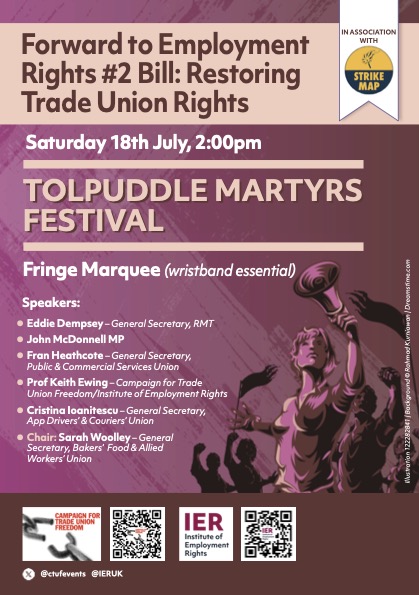
The Campaign For Trade Union Freedom will be holding a spring rally in London on 21st March to launch the campaign for a second Employment Rights Bill to close loopholes and bring forward the workers rights and protections promised in Labour’s New Deal For Workers. More information soon.
US VW Workers To Vote On First Contract After Unionising Chattanooga Plant

In a historic win for workers’ rights in the US South, the United Automobile Workers (UAW) and the German auto manufacturer Volkswagen have reached a tentative new contract agreement at the company’s plant in Chattanooga, Tennessee.
The deal covering 3,500 workers marks the culmination of two years of sustained organising and collective bargaining negotiations since employees in Chattanooga voted 3 – 1 to join the UAW in April 2024.
The VW Chattanooga plant, was until the 2024 vote, the last VW operation anywhere in the world that was non union.
The organising campaign in Chattanooga was itself a breakthrough for US unions in the traditionally anti union US South. Earlier union organising campaigns in 2014 and 2019 had failed.
The union win in 2024 came after a complex and prolonged battle with company management, who had engaged in a high profile anti union campaign at the plant and the tentative contract marks a big breakthrough for non-union autoworkers and manufacturing workers across the US South.
The tentative deal ensures that Volkswagen workers will have a legally binding and enforceable agreement that guarantees a 20% pay offer, fair pay, more affordable health care, safer working conditions, and clear protections against favouritism.
“For years, Chattanooga workers were told to settle for less while Volkswagen made record profits. So, the workers stood together and won their union – and now they’ve secured a life-changing first agreement,” said UAW President Shawn Fain who has lead the UAW campaign to unionise non union auto plants in the southern states.
On his election in 2023 as union president he put non union auto plants and in the supply chain in the south states on notice that the UAW would be mounting mount strategic and well funded organising campaigns.
Anti union campaigns in the Southern States have traditionally used union busting tactics including wide spread media advertising, mandatory captive audience meetings of workers addressed by managers and company lawyers, one-on-one meetings to intimidate workers threats of violence and threats of plant closures.
For workers like bargaining committee co-chair Steve Cochran, a skilled trades worker the agreement represents a turning point. “A strong contract makes sure promises are delivered. Respect and security shouldn’t be up for negotiation—and now they won’t be.”
The tentative agreement is especially significant given Volkswagen’s recent record-breaking profits. In 2024 alone, the world’s second-largest automaker reported $20.6 billion in profits—even as Chattanooga workers struggled under substandard health coverage and rising out-of-pocket costs.
During the contract campaign in Chattanooga, the management tried to decertify the union after the 2024 vote .
In December last year after the UAW voted to authorise strike action a website was launched advocating that workers break with their union and take Volkswagen’s previous “last, best and final” offer. “Decertify the UAW and take your raise without all the drama,” the site said.
“This deal proves what happens when auto workers stand up and demand their fair share” said President Fain. People said Southern autoworkers could never form a union or win a union contract. Volkswagen workers in Chattanooga said, ‘Watch this.’”
Support Latin America’s workers and their unions against the “angry tide” far-right offensive
The abduction of Venezuelan President Nicolás Maduro and First Lady, Cilia Adela Flores, represents a clear and present danger to the Latin American working class, their unions, and indeed the overwhelming majority of Latin American people.
This is an attack on Venezuelan sovereignty and constitutes a threat to all countries (including Cuba, Columbia and Mexico) in Latin America and the Caribbean that assert their right to self-determination and who defend their sovereignty.
The reassertion of the Monroe Doctrine originally said to be aimed at excluding European and other powers from the western hemisphere but in reality to give US capital exclusive rights over Latin America’s natural resources fits in with the “angry tide” of newly emergent right wing leaders in Latin America, natural allies of Trump and willing collaborators with US imperialism.
In Venezuela and Brazil, previously in Ecuador, and elsewhere the nation’s resources have been used to fund social programmes for the benefit of the people; the “angry tide” will revert to neo-liberal models, economic policies that for the past forty-five years have facilitated the global transfer of wealth from working people to the super-rich and the corporate sector.
Leading the “angry tide” Argentinian President Milei’s central economic policy of “anarcho-capitalism,” an extreme variant of neo-liberalism has bankrupted the country which is now in hock to the US financially as well as being ideological bedfellows.
An essential and enduring feature of these policies is the restriction or even elimination of labour rights; usually a restriction on the right to organise, the right to collective bargaining and the right to strike.
Trump’s statements make it clear that the US intends to take control of Venezuelan oil revenues, which are the basis of the entire social programme underpinning theBolivarian Revolution, as well as the sector being the largest industrial employer with the strongest unions. We may anticipate a major assault on labour rights and even on labour activists in the sector.
This anticipated attack chimes with Milei’s agenda of saying that protestors should face either “prison or bullet.” He is also known to have the country’s women’s and environmental movements in his sights, just as the far-right Bolsonaro Presidency did in Brazil.
The US attack on Venezuela is no doubt also a precursor of great struggles to come across many sectors in many countries against an ideology that promotes authoritarianism, climate change denial, extreme austerity and social discrimination.
There are at least four union federations in Venezuela; dealing with the aftermath of the US attack has limited the scope for any possible united response. However, the President of the Chávista union federation, the Central Bolivariana Socialista de Trabajadores (CBST), Will Rangel says “The working class reaffirms its loyalty to the Bolivarian Government.”
Clearly the US has Cuba in its sights. For 60 years Cuba has been a beacon for others in Latin America showing that another world is possible. Control of Venezuelan oil, cutting off supplies to Cuba, is a blatant attempt to snuff out this light of the good example.
The “angry tide” is part and parcel of the trend towards right wing populism and authoritarianism that we are witnessing in Europe. Their fight against Trump and the “angry tide” is our fight; when all’s said and done, it is all part of the same struggle.
You can add your name to the call to oppose Trump’s war on Venezuela here:
https://www.venezuelasolidarity.co.uk/2025/11/07/emergency-statement-no-to-trumps-war-on-venezuela/
You can add your name to the call to defend international law and say no to intervention in Cuba and Latin America here:
https://cuba-solidarity.org.uk/peace-and-sovereignty/
This blog first appeared on Labour Outlook https://labouroutlook.org/2026/01/17/support-latin-americas-workers-and-their-unions-against-the-angry-tide-far-right-offensive/